
1The premise
An owner-operator with half a dozen to a dozen services — on a laptop, a Mac mini, EC2 instances, a server in another country — accumulates the same three problems: nobody knows what is running where, every machine holds API credentials its own way, and every SQLite database is backed up differently or not at all.
Keep answers all three with one deliberately small mechanism: give every deployment a cryptographic identity, then attach three passive capabilities to it — report status, lease secrets, deposit backups. One binary, one instance, one bucket, one key.
2The principle
Keep has no operational power over the services that use it. It does not start, stop, restart, deploy, restore, or run commands on their behalf. Each service remains independently operated and fully responsible for its own runtime behavior. Credentials and backups are opaque objects: Keep stores and returns them but never interprets their contents or uses them to act on anything.
The test for every future feature: does it merely record, store, or provide something — or does it cause another service to act? The latter stays out.
3What it holds

A registry of services and deployments
Every enabled deployment reports in every five minutes over its mutually authenticated
connection: health, running revision, uptime. Keep records only the
latest state — it is an inventory, not a monitoring platform. An enabled deployment that
falls silent for fifteen minutes shows offline. Each enabled deployment's
running revision is compared against a desired revision declared at deploy
time — by the administrator, or by a deployment for its own service —
yielding a plain verdict: current, different, or
unknown.
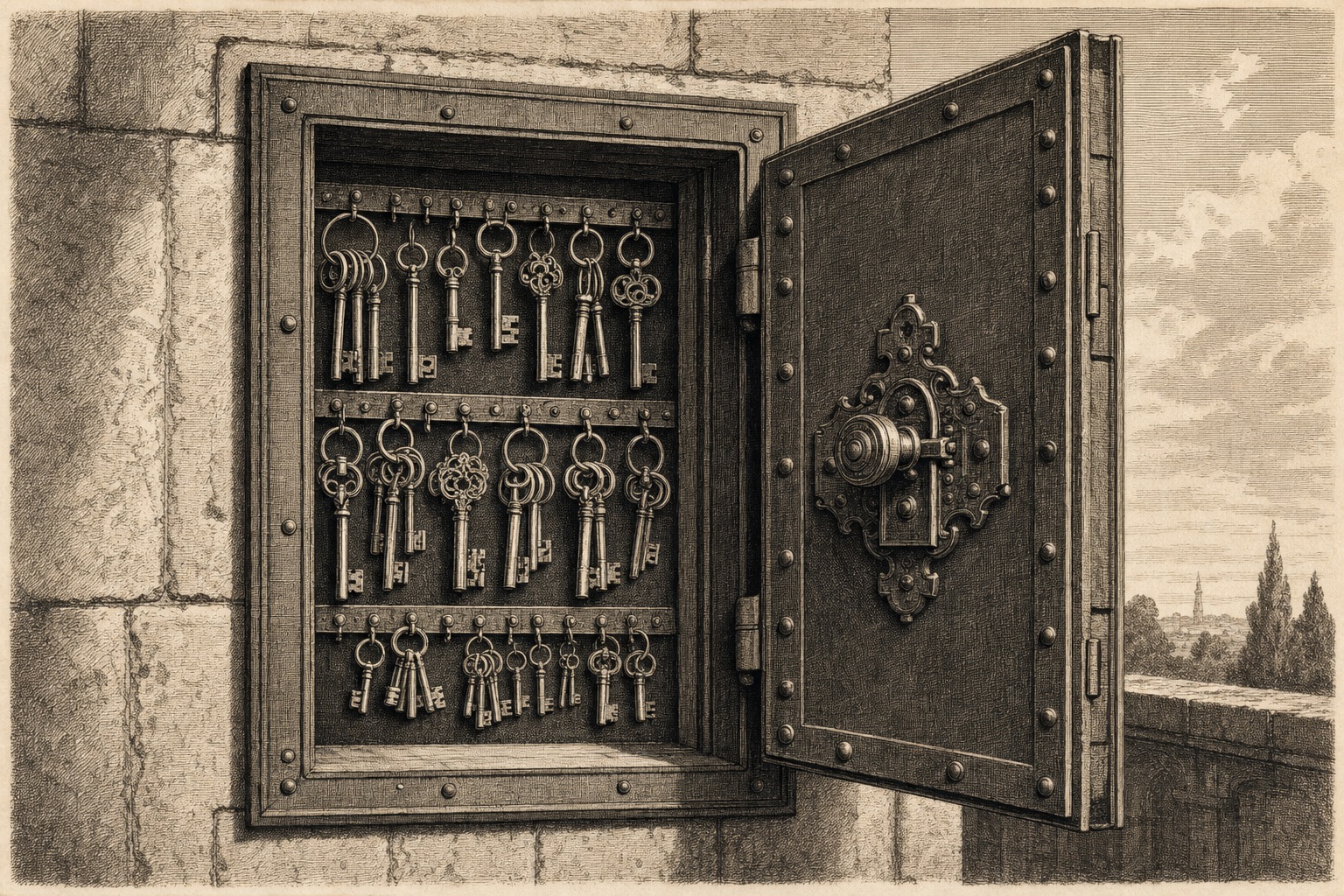
Custody of credentials
Secrets are named per service — openai, email-provider,
aws-archive — encrypted under AWS KMS with the service, name, and
version cryptographically bound to the ciphertext. Values enter through the
administrative API and leave only through deployment leases; there is no
endpoint that reads a secret back to an administrator — not even a fingerprint of
it. Leases are soft: a freshness contract for cooperating clients, renewed
twice a day, never mistaken for revocation — only the upstream provider can truly
revoke a credential, and the design refuses to pretend otherwise.

An archive of database backups
Each service names its SQLite databases; each deployment validates and snapshots
them consistently (VACUUM INTO), gzips the snapshot, and uploads it
with a declared length and digest. Keep verifies size and checksum while streaming
the compressed bytes into a versioned S3 bucket — never spooling them to its own
disk, never looking inside. Backups are retrievable only by an administrator, and
every download is an audit event. There is no restore endpoint: restoration is a
human decision, made with a downloaded file.
4How it speaks
Everything is an API. There is no web console, no sessions, no passwords. Two kinds
of principal exist — administrators and deployments — and both authenticate the
same way: mutual TLS with pinned Ed25519 keys. Each machine generates its own key
and self-signed certificate; the administrator registers the public-key fingerprint;
the TLS handshake itself proves identity on every request. Private keys never leave
the machines that generated them. The API lives on its own hostname —
api.keepcentral.com — which is the only one that ever asks for a
certificate; the page you are reading never will.
Deployment endpoints use /self — the authenticated key already says
who is calling, so a client cannot name, or impersonate, anyone else:
PUT  /v1/self/status
GET  /v1/self/secrets
POST /v1/self/secrets/{name}/lease
POST /v1/self/databases/{name}/backups
POST /v1/self/desired-revision
A lease response, in its entirety:
{
  "name": "openai",
  "version": 7,
  "media_type": "application/json",
  "issued_at": "2026-07-12T16:00:00Z",
  "refresh_after": "2026-07-13T04:00:00Z",
  "soft_lease_until": "2026-07-13T16:00:00Z",
  "payload": { "api_key": "…" },
  "payload_base64": "…"
}
The deployment side of this conversation is a separate, open-source
Go module: xoba.com/keep
(MIT) — an SDK and CLI holding everything a service needs. Status
keep-alives, secrets leased once and renewed in the background, backup
upload, and one deploy-time write: a deployment publishing the desired
revision of its own service. The server and the SDK are independent
codebases that share no code; the wire contract published in the SDK
repository is the entire boundary between them.
The server itself is one Go binary and one of everything it needs:
5What it refuses to do
Most of Keep's design is subtraction. It provides no web interface, no user accounts, no CI/CD, no redeployment or restart of anything, no automatic credential rotation, no automated database restoration, no git-provider integrations, no metrics or log aggregation, no remote command execution of any kind. A compromise of Keep is treated, honestly, as a compromise of everything it holds — which is precisely why it holds little, does less, and audits all of it.